



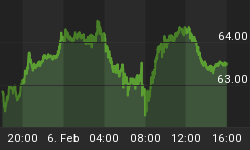


Prices are influenced by two forces. Inflation, caused by monetary expansion, is an increase in the general price level. That influence is felt directly though domestic prices rising and through a depreciating national money forcing imported prices higher. Additionally, prices on a relative basis can change. In the Agri-Food sector both influences have been felt. Prices for Agri-Food commodities have moved higher on a relative basis as a massive global demand shift has occurred. Economic expansion in BRIC, Brazil, Russia, India, & China, is increasing demand for higher value Agri-Food products. A falling dollar, in which most commodities are price priced globally, has also contributed to rising Agri-Food prices. In this week's graph the ratio of the Schmidt Base Agri-Food Index divided by the price of $Gold is plotted. When that ratio is rising, Agri-Food prices are rising more than $Gold's price.

As the chart portrays, Agri-Food prices have risen faster than the price of Gold. Gold can defend a portfolio against the wrath of monetary inflation and a depreciating national money. It is, perhaps, not always the best defense against the movement of relative prices, such as Agri-Food or oil. An asset improves a portfolio's wealth characteristics if it offers higher returns and that return is uncorrelated with return on remainder of portfolio. Agri-Food commodities may offer, at a minimum, a return competitive with Gold at this point in time. And importantly, the covariance between Agri-Food prices and Gold is running at zero at the present. Investors interested in defending their wealth against the ravages of rising prices should consider combining Agri-Food investments with their Gold holdings.
AGRI-FOOD THOUGHTS are from Ned W. Schmidt,CFA,CEBS, publisher of Agri-Food Value View, a monthly exploration of the Agri-Food grand cycle being created by China, India, and Eco-energy. To review a recent issue, write to agrifoodvalueview@earthlink.net.